April 10, 2026
You're deploying AI right now. Or you're about to.
Scheduling agents. Triage bots. Automated ticket routing. Copilot integrations. AI-assisted documentation. The tools are real, the vendors are loud, and the pressure to move fast is coming from every direction.
So you're moving fast.
And you're about to find out that fast was the wrong direction.
Not because the tools don't work. They work. Not because the technology isn't ready. It is. The problem isn't the AI. The problem is what the AI has to work with. And right now, what it has to work with is a pile of your ticket data, a few SOPs, and absolutely nothing that tells it what your business actually stands for.
You can train an AI on your processes. You can feed it your ticket categories, your escalation rules, your SLA windows, your documentation templates. All of that goes in, and the AI executes against it. Fast. Consistently. Without complaining or getting tired on a Friday afternoon.
But here's what you can't train into an AI: values.
Values aren't rules. They're judgment calls made in ambiguous situations where the rules don't clearly apply. They're what your best tech uses when two things are technically correct and only one of them is right. And the only way an AI can get anywhere near that kind of judgment is if your values are explicitly documented - not as slogans, but as behavioral standards with real examples of what living them looks like and what violating them looks like.
A value that isn't documented isn't a value for your AI. It's invisible. And invisible values don't guide decisions. They get ignored - not out of malice, but because the AI never knew they existed.
THE SCENARIO THAT'S GOING TO HAPPEN IN YOUR SHOP
It's a Tuesday morning. Your AI triage agent is routing tickets.
Two come in at the same time.
Ticket one: a minor connectivity issue for your largest client. $8,500 a month. Forty seats. The issue is affecting one user and she has a workaround. Not urgent. But it's your biggest account.
Ticket two: a work-stoppage emergency for a small medical clinic. $800 a month. Six seats. Their entire system is down. Nobody can access patient records. The clinic is at a standstill.
Your AI looks at the signals it has. Revenue. Seat count. SLA tier. Client history. It routes ticket one first.
And it just violated the most important value your business has.
Because your value - the one you've said out loud a hundred times, the one you said in your last all-hands meeting, the one that made you proud to build this business - is that every client's work matters. Not every client's revenue. Their work. The thing they need to do. The people depending on them to do it.
Your clinic is down. Someone can't pull a patient record. And your AI sent a tech to fix one user's connectivity issue at your biggest account first.
No one in your building made that decision. Your AI did. With the only information it had.
And the information it needed - your values, your mission, the reason you built this business - was never written down anywhere it could find.
THE THREE THINGS YOUR AI NEEDS BEFORE YOU DEPLOY IT
This isn't a warning against AI. It's a requirement list for your AI. There's a difference.
An AI agent that has the right foundation is extraordinary. It makes decisions faster than any human, more consistently than any team, and without the emotional variability that makes Tuesday morning different from Friday afternoon. You want that. You should want that.
But an AI agent without a foundation is a powerful tool making decisions in a vacuum. And the decisions it makes in that vacuum will reflect whatever signals it has - ticket volume, revenue, SLA windows - and nothing else. Nothing about who you are. Nothing about why you built this business. Nothing about what you promised your clients when you shook their hand.
Here's what your AI needs before it touches a single decision.
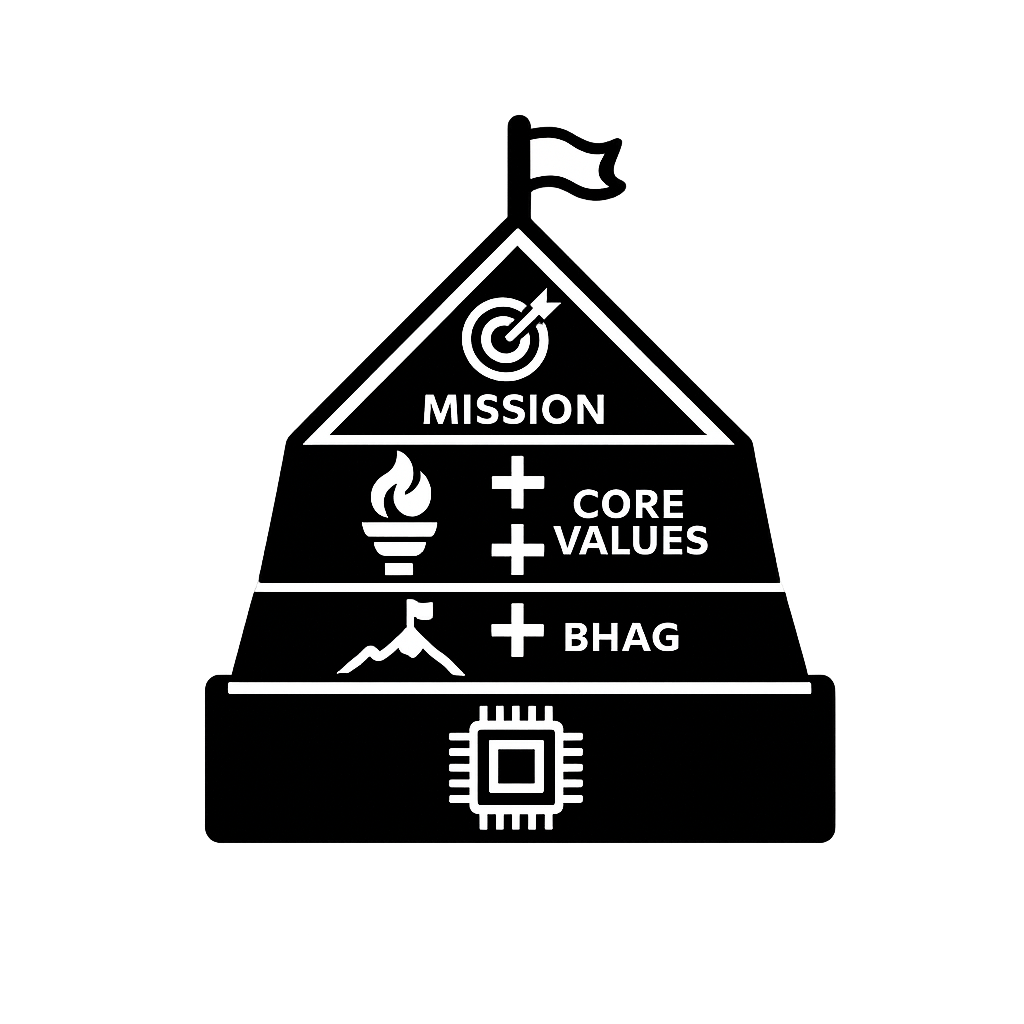
Your mission. Your mission tells the AI what matters. Not what's efficient. Not what's profitable. What matters. "We protect the businesses that protect people" is a mission that tells an AI how to weight a decision when two things are competing. The clinic wins. Not because the revenue is higher - it isn't - but because protecting the work they do is exactly why you built this business. Without your mission, the AI doesn't know that. It knows your billing data.
Your core values. Your values tell the AI how to behave. Not just what to do, but how to do it. "Every client's work matters equally" is a value that changes the triage scenario completely. But only if it's documented. Only if there are behavioral examples attached to it. Only if the AI has been given something specific enough to act against. A value that lives in your head or on a poster in your break room is invisible to every AI agent you'll ever deploy.
Your BHAG. Your BHAG (your big hairy audacious goal) tells the AI what success looks like at scale. It's the north star that keeps every small decision pointed in the right direction. When your AI is routing tickets and making micro-decisions a hundred times a day, the BHAG is what keeps those decisions adding up to something. Without it, the AI optimizes for whatever metric is easiest to measure. Usually speed. Usually revenue. Rarely meaning.
Your mission tells it what matters. Your values tell it how to behave. Your BHAG tells it what it's building toward. All three. Documented. Specific. In your field guide. Before you deploy anything.
WHAT IT LOOKS LIKE WHEN YOUR FOUNDATION IS THERE
The same Tuesday morning. The same two tickets.
But this time, your AI has been built on your foundation. It has your mission. It has your values with behavioral examples. It has your BHAG and understands the kind of business you're building.
Ticket two routes first.
Not because a rule said so. Because your AI understands that you exist to protect the work people depend on, and a clinic that can't access patient records is exactly the scenario your mission was written for. The decision took milliseconds. It was consistent with every other decision your AI will make today, tomorrow, and six months from now.
Your biggest client's issue goes into the queue. It gets handled. Professionally, on time, with the right tech. The SLA is met.
And your small clinic never knew they were one decision away from being second.
That's what your foundation does. It doesn't slow the AI down. It makes the AI's speed worth something. It takes all that processing power and consistency and points it at the outcomes you actually care about - not just the ones that are easy to measure.
This is the difference between AI that executes and AI that represents you.
THE OWNERS WHO BUILD THIS FIRST WILL WIN
Here's what's coming.
If you deploy AI without your foundation in place, you'll eventually have your version of the Tuesday morning scenario. One of your clients will get a wrong outcome. Not a broken outcome - the ticket will get closed, the SLA will get met, the metrics will look fine. But the outcome will be culturally wrong. It'll violate something you care about deeply and never thought to write down.
And here's the hard part: you won't be able to explain it. Because no one in your building made the decision. Your AI did. And it did exactly what it was built to do. It just wasn't built to be you.
The owners who build the foundation first - who document their mission with operational clarity, who turn their values into behavioral standards with real examples, who put their BHAG in front of every agent they deploy - those owners will have AI that actually represents their business. Fast and consistent and culturally correct.
That's not a different AI tool. That's the same AI tool with your foundation underneath it.
Your field guide is that foundation. Not because it's a nice document to have. Because it's the only place in your business where who you are is written down clearly enough for a machine to act on it.
BEFORE YOUR NEXT DEPLOYMENT
Open your field guide. Go to the foundation section. Mission, core values, BHAG. Read what's there.
If your mission is vague, make it specific. If your values are slogans, add behavioral examples - what living each one looks like, what violating each one looks like. If your BHAG is a revenue number, rebuild it into something your team and your clients can run toward together.
Then build your AI on top of that.
Your AI can wait. Your foundation can't. Every day you deploy without it is a day your AI is making decisions that reflect your data instead of your values. And your data doesn't know why you built this business.
You do. Write it down.
Start your field guide at builttorunmsp.com
FREQUENTLY ASKED QUESTIONS
What does an AI agent need to make good decisions in my MSP?
Your AI agent needs three things beyond technical training: a documented mission that defines what matters, core values with behavioral examples that define how decisions should be made in ambiguous situations, and a BHAG that defines what success looks like at scale. Without these, your AI optimizes for whatever signals it has - usually revenue, speed, and volume. Those signals produce technically correct decisions that are often culturally wrong. Your AI knowing your mission routes the clinic ticket first. Your AI only knowing your revenue routes the big client ticket first. Same tool. Completely different outcomes.
How do my core values apply to AI decision-making?
Your core values are judgment calls - what your best people do when two things are technically correct and only one of them is right. For your AI to approximate that judgment, your values have to be explicitly documented with behavioral examples. Not slogans. Specific descriptions of what living the value looks like in a real work scenario and what violating it looks like. "Every client's work matters equally" is a value. "When two tickets arrive simultaneously, priority is determined by impact to the client's ability to do their work, not by revenue tier" is a behavioral standard your AI can actually act on. The more specific your documentation, the more accurately your AI reflects your culture.
What does it mean to be AI-ready?
You're AI-ready when you've documented your operating foundation before deploying any AI tools. That means a mission statement specific enough to guide decisions, not just describe your business. Core values written as behavioral standards with real examples of what following them and violating them looks like. A BHAG that gives every agent a north star for what you're building toward. On top of that, your key processes need to be documented with outcomes, measurements, and feedback loops - so your AI knows not just what to do, but how to know if it did it right. The technology is almost always ready before your documentation is. That gap is where culturally wrong decisions happen.
Why do I need to document my foundation before deploying AI?
Because your AI executes against what it has. If what it has is ticket data and SLA windows, it optimizes for ticket data and SLA windows. If what it has is your mission, your values, and your BHAG, it optimizes for those. The documentation doesn't change the tool. It changes what the tool is pointed at. If you deploy without your foundation, you'll spend months troubleshooting decisions that are technically defensible and culturally wrong. If you build your foundation first, you'll spend that same time watching your AI make decisions you're proud of.
Where does my mission, values, and BHAG documentation live?
In the foundation section of your field guide - the first section, before any operational system or process. It's the operating context document for every decision your business makes, human or AI. Every new hire reads it on day one. Every manager references it when making people decisions. Every AI agent gets trained against it before deployment. It's not a culture document. It's not an HR artifact. It's the thing that makes every other system in your field guide point in the same direction.

Adam Kuester
Adam Kuester has a PhD in genetics and a career built inside managed services, an unusual combination that shapes how he works. He spent time designing operations at an MSP before joining Bruce McCully to build Galactic Advisors, where he's served as VP of Special Projects. His focus has been operational: finding gaps, building systems, and turning expertise into tools MSP owners can use across a partner base of nearly 1,000 companies. Built to Run MSP is that same work in a different form, practical frameworks for MSP owners who are good at winning business and want to get equally good at running it.